
Whalefall
Release Year: 2026
Directed by: Brian Duffield
Cast:
Austin Abrams
Josh Brolin
Elisabeth Shue
Jane Levy
John Ortiz
Whalefall
Whalefall Is Swallowed by Its Own Sentimentality
By: Marc Kozak
It probably didn't take you very long to decide if you wanted to see Whalefall or not. Once you know even the tiniest sliver of its basic premise — a man gets swallowed by a whale and tries to escape — you likely already know if you're on board or not. As you might expect, there are plenty of awesomely ridiculous (or ridiculously awesome) scenes in which a young man deals with the perils of being inside a whale's digestive system, but what you might not expect is the equal amount of time spent on a similarly perilous emotional journey between the young man and his recently deceased father. Even though director Brian Duffield does an admirable job weaving in the fairly standard daddy-issues plot that comes from the source material (a 2023 novel by Daniel Kraus), the mawkish sentimentality somehow ends up feeling even more absurd than the actual whale escape, which is really saying something.
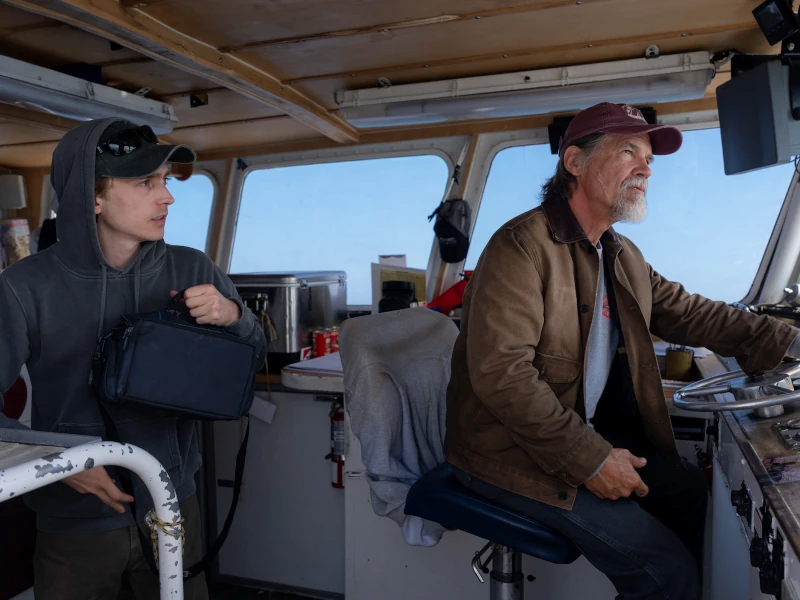
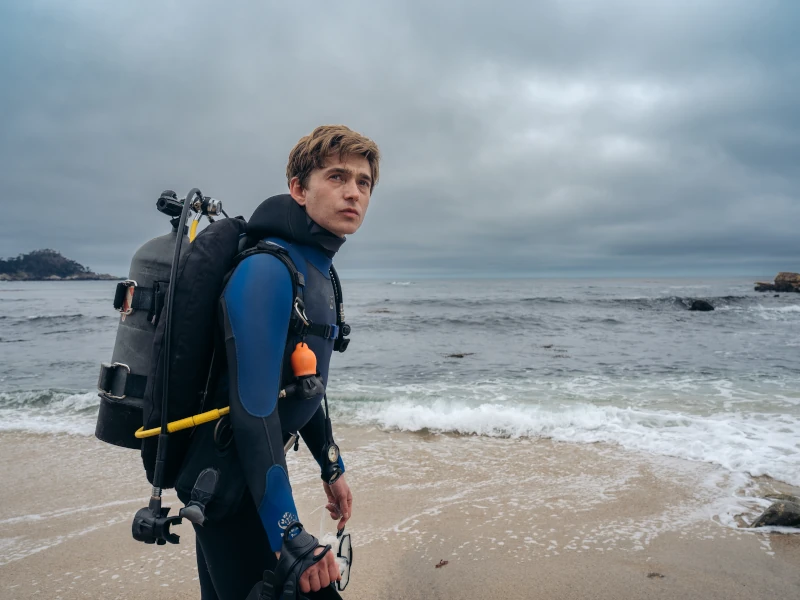
The brisk prologue introduces us to college student Jay (Austin Abrams), back in his coastal California hometown for a visit to see how his family is doing a year after the death of his father, Mitt (Josh Brolin). Jay's mother and sisters remain troubled by the nature of Mitt's death, in which he decided to commit suicide by tying weights to himself and jumping into the Pacific Ocean rather than dying slowly of cancer in a hospital bed. There was no body to put in a casket, no ashes to scatter at a final resting place, no sense of closure for the family. Even though it's made abundantly clear that Jay and his father did not have the best of relationships, Jay nevertheless decides to go diving to try and find his father's remains, setting out on his own without telling anyone of his intentions.
Jay is no slouch in the water; he reluctantly picked up a decent set of skills during a childhood spent on a boat with his father, who was a scuba-diving tour guide known as a diving legend in the community. Jay was never that interested in following in his father's footsteps, which didn't sit well with the gruff and overbearing Mitt. In a series of flashbacks, we see Brolin as a tattooed, hippie-ish sea dog, forever cursing the landlubbers for not respecting the majesty of the sea, constantly trying to impart his watery philosophies to a young son who would rather be anywhere else. Jay's sisters (Jane Levy and Emily Rudd) frequently expressed frustrations that Jay never made amends before Mitt's passing, but they never had to bear the brunt of Mitt's impossible expectations and increasingly drunken fury, a burden that Jay's mother (Elisabeth Shue) somberly understood. Mitt was a right bastard, and Jay couldn't wait to grow up and get out of town. Returning home after Mitt's death simply resurfaces a lifetime of resentment that Jay has yet to properly deal with.
" It’s a movie that climaxes with the sort of epiphanies that could have been reached with just minutes of therapy, all neatly (if not stupidly) juxtaposed with the figure of a whale with a man inside it. "
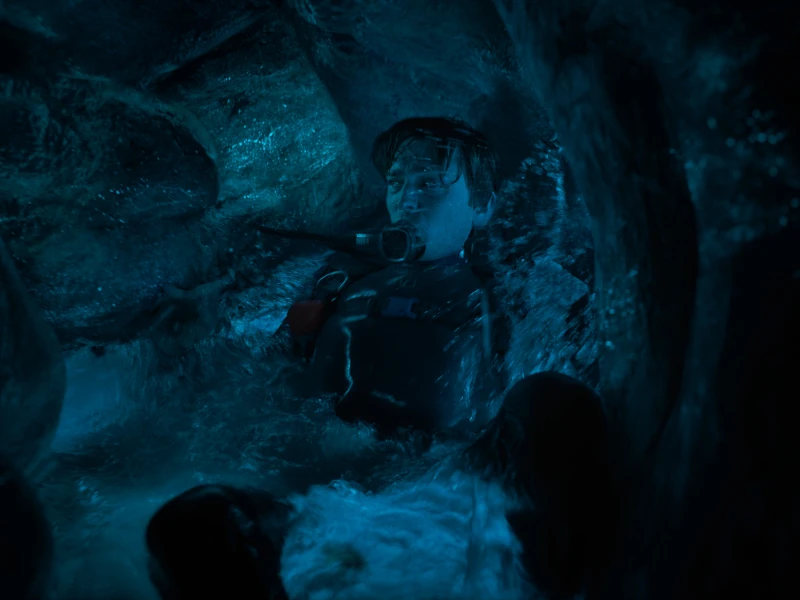
So under the water we go, as Jay ignores weather conditions and an ominous gathering of the local Coast Guard to scan the ocean floor, equipped with a tank containing one hour of oxygen. It's not long before he gets caught in the middle of a struggle between a giant squid and a sperm whale, swallowed whole and stuck in a series of goopy chambers that are actively trying to break him down so he can be digested. The internal environment of the whale is quickly established — there's the stomach, which acts as a living trash compactor, a chamber full of flesh-dissolving bile, and a "throat” of sorts, where the whale's enormous tongue prevents anything from coming back out through the mouth. Jay doesn't have much to work with, other than his rapidly decreasing oxygen, some basic scuba supplies, and a glow-in-the-dark jellyfish. Things don't look good.
The scenes inside the whale are utterly engrossing, as Jay must use his survival skills to combat a never-ending series of crises. Mucous-covered walls contract and expand without warning; other frightened swallowed animals lash out in desperation; the effort and physical toll of going from one chamber to the next cause Jay to black out on more than one occasion. It's a house of gloopy horrors, shot with claustrophobic intensity by cinematographer Aaron Morton.
Austin Abrams, fresh off starring roles in Resident Evil and Weapons, has become Hollywood’s go-to guy when you need an everyman to react incredulously to extraordinary situations without many other actors around to bounce off of. He excels at the art of muttering, cursing, and yelping in pain; when he gives a full-throated scream after almost making it past the whale’s tongue, you can’t help but want him to succeed. He’s a mild-mannered leading man that you don’t mind spending time with, his character in Whalefall being the latest in a series of roles that easily trigger your empathy due to his skill at portraying a relatable sense of overwhelmed anxiety.
The final third of Whalefall doubles down on the hokey emotional beats, as it becomes apparent that the whale is a stand-in for Jay’s father, something that he wants to escape but can still learn from and appreciate. He starts to remember conveniently flashbacked moments that give him the tools to get out of various anatomical traps. Composer Joseph Trapanese cranks up the strings for maximum impact as Jay starts to talk to the whale, and the whale responds as Jay’s father, giving the pair a surreal opportunity to have the kinds of conversations they were never able to have while Mitt was alive. It’s all a bit much, even in a movie featuring a man trapped inside of a whale, and any momentum built up from the pulse-pounding survival sequences grinds to a halt.
You can understand Duffield and Kraus’ desire to ground the story in something resembling realism, but the introduction of this kind of melodramatics has the opposite effect here, making the viewer wish the movie had just gone into full-blown whale-sanity, logic and reason be damned. For every preposterously amazing shot of the whale diving into the terrifying abyss or dramatically fending off a squad of hungry orcas, we are somehow met with even more preposterous emotional and spiritual revelations. It’s a movie that climaxes with the sort of epiphanies that could have been reached with just minutes of therapy, all neatly (if not stupidly) juxtaposed with the figure of a whale with a man inside it.
Still, there’s more than enough here to entertain and even thrill at times; you have to admire Duffield’s sheer audacity and skill in crafting such clear and exciting action sequences in an extremely unique setting. It’s just kind of a shame he decided to give equal time to the interiority of both man and whale — one of those is far more interesting than the other.