
Spider-Man: Brand New Day Review
The Long Road Back to Being Peter Parker
By: Marc Kozak
Spider-Man: Brand New Day
Release Year: 2026
Directed by: Destin Daniel Cretton
Cast:
Tom Holland
Zendaya
Sadie Sink
Jacob Batalon
Jon Bernthal
Spider-Man: Brand New Day
The Long Road Back to Being Peter Parker

By: Marc Kozak
One of the most common themes in superhero storytelling is how our heroes often believe that they have to sacrifice relationships and personal happiness in order to succeed. Our costumed adventurers love to play the lone wolf, whether it’s because they have powers that set them apart from the rest of society or they have a secret identity to prevent their loved ones from being put in danger. I can’t tell you how many Batman stories I’ve read where, despite having dozens of close allies that would drop whatever they’re doing to lend a hand, Batman stupidly plunges headfirst into danger by himself. “I have to do this on my own!” he usually says at some point, before inevitably getting rescued and learning a valuable lesson (for the hundredth time) about the value of friendship.
Spider-Man is probably the peak example of this idea, a young man led by the ethos that “with great power comes great responsibility.” To him, that responsibility means he is morally obligated to use his special gifts to help others, even at the expense of his own happiness. For many years, this character trait has given writers the opportunity to dump as much tragedy as possible on the poor guy, because he has to just sit there and take whatever disasters befall his personal life: it’s all secondary to his duties as Spider-Man.
How refreshing that Spider-Man: Brand New Day, the fourth film in the MCU Spider-Man series, finally finds Peter Parker realizing that he has to give equal time to the man and the spider, and then using that personal growth to help another superpowered young person at the beginning of their own similar journey. It’s a simple but well-executed thematic throughline that, combined with a more back-to-basics, street-level approach to our favorite neighborhood wall-crawler, helps make this one of the most satisfying superhero movies in some time.
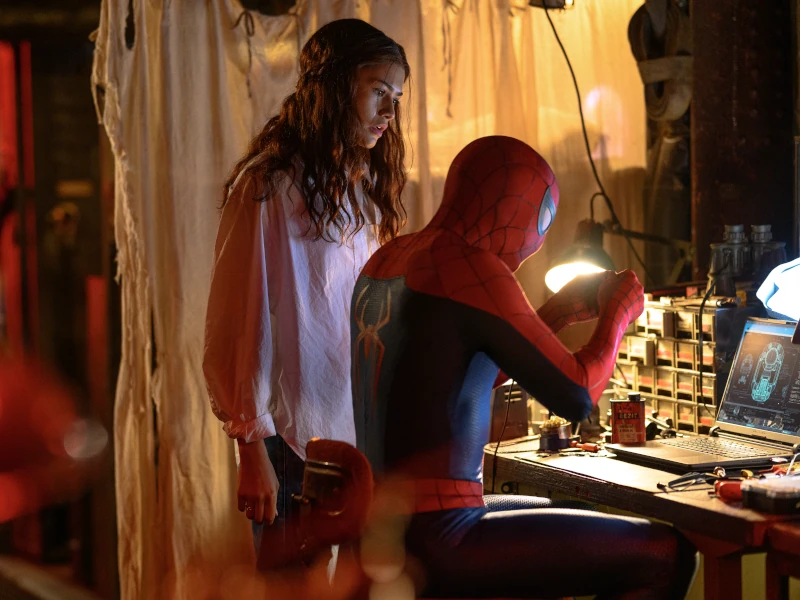
As the story opens, we find Spider-Man (Tom Holland) reeling from the events at the end of No Way Home, in which the entire world, including his partner M.J. (Zendaya) and best friend Ned (Jacob Batalon), were made to forget that Peter Parker ever existed. Due to these severe personal losses (as well as the loss of his Aunt May), he loses himself in his crime-fighting responsibilities for years, ridding New York of crime and even becoming a welcome partner to the New York police department. The city loves Spider-Man, and for Peter, that’s good enough, even if he has to spend his days completely alone, living in a dank attic filled with computers and spiderwebs, occasionally spying on M.J. and Ned’s social media accounts to watch their progress as they attend and eventually graduate from MIT.
" It wins a lot of points for injecting a bit of humanity into a franchise stuck on multiversal apocalypses, and even if that seems like small progress, it’s progress that desperately needed to happen. "
His only regular human interaction is with Detective DeWolff (Liza Colon-Zayas), who he coordinates with to track down crimes in progress, and even she is starting to become concerned at Spider-Man’s loneliness and accompanying increase in headaches. Screenwriters Chris McKenna and Erik Sommers take an interesting approach to the ramifications of Peter’s isolation: as he starts to be less Man and more Spider, he starts to physically transform, his eyes blackening and his actions more aggressive, until webs start to shoot out of his actual body instead of his classic web-shooting mechanisms. He clearly hasn’t dealt with the loss of M.J. in his life, and he clings to the letter he wrote but never delivered to her at the end of No Way Home, in which he told her everything that had happened with a promise to remind her who he is and what she meant to him.
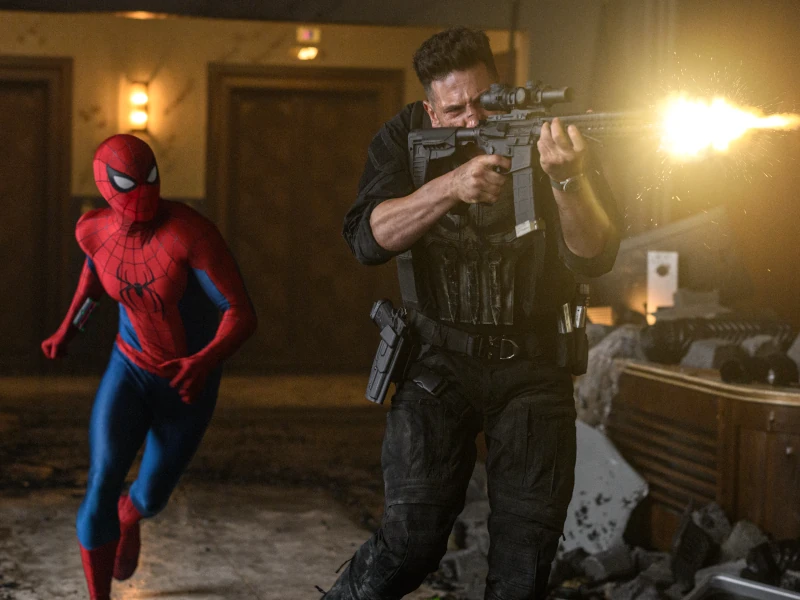
A mysterious body-hopping villain appears around the same time Peter’s physical issues really start to escalate, leading him to do a quick tour of characters from the larger MCU. The inclusion of these other characters feels forced and really halts the story’s momentum. Is it too much to ask for one superhero movie to go without multiple cameos that serve little purpose other than for fans to point at the screen in recognition? Florence Pugh’s Black Widow appears only to lounge in a spa and dump exposition. Bruce Banner aka The Hulk (Mark Ruffalo) shows up to repeat the themes of the movie out loud. Most confounding is the repeated inclusion of Frank Castle aka The Punisher (Jon Bernthal), a violent killer of a character that has little reason to do the whole buddy cop schtick with Spider-Man, much less spend most of the movie as the inexplicable comic relief.
Tom Holland continues his excellent work as Peter Parker, effortlessly providing the character with a more mature, dramatic tone (it also helps that the actor is now 30 years old). Director Destin Daniel Cretton (Short Term 12, Shang-Chi) effectively shifts the tone ever so slightly in the direction of adulthood — and by that, I mean less jokey banter, more brooding accompanied by indie rock musical cues. It’s a small but noticeable shift from the previous Spider-Man movies, and Holland responds to it by delivering one of the best performances of his career. His grief is palpable, particularly in any of the scenes in which he tries to reintegrate himself into the lives of M.J. and Ned. The scenes with Peter and M.J. isolated in simple conversation are charged with electricity, as Holland and Zendaya’s natural chemistry and likability lends an extra weight to the tragedy of the lost relationship between their characters. When all of Peter’s secrets are finally laid bare late in the movie, there’s an almost unbearable tension between the two, resulting in one of the more emotionally affecting scenes you’re likely to get in a movie like this.
The introduction of Sadie Sink as the mysterious telepathic antagonist is also a big plus for the movie (and the MCU in general going forward). It’s hard to say much without spoilers, but her character is a slightly surprising spin on a very familiar Marvel character, and it works like gangbusters. The reveal of her backstory dovetails wonderfully with Spider-Man’s own gradual emergence from his grief and self-imposed isolation, giving the two characters a unique commonality that is neatly expressed in the story’s climax. Sink has that unique “it” quality that makes it impossible to look away when she’s on the screen, and it’s exciting to think about the future as she grows into a very important role within the MCU.
There is noticeably less action in Brand New Day, which isn’t necessarily a bad thing. We get a few scenes of Spidey fighting The Scorpion (Michael Mando), a basic criminal in mechanized armor that shows up a few times only to get punched out fairly easily. After years of keeping The Hulk at bay, Bruce Banner is forced into the transformation only to briefly fight Spider-Man, destroy a building, and then fade out of the story, the latest in a line of familiar (and kind of sad) cameos for a character that used to carry his own feature films. Maybe the standout sequence is a fairly creative fight with a group of ninjas from The Hand (who are also being controlled by Sadie Sink’s character), allowing for some fairly interesting displays of power. But for the most part, the drama here is mostly internal, which may cause some anxious foot tapping from those who want to see more fireworks.
If anything, there is far too much material here that distracts from the main event, which is Peter and M.J. coming to terms with their newly mismatched relationship. It is far and away the most exciting part of the movie, a thread that often disappears for far too long. It’s hard to say if Cretton and his team were mandated to put in all of the distracting cameos and set-up for future movies (okay, it’s very likely), but it’s not hard to imagine that the movie would’ve worked a lot better with about 30 minutes shaved off of it.
It’s also hard not to get a little annoyed by the movie’s refusal to actually progress the Peter/M.J. story, which basically winds up in an all-too similar place by the time the movie ends (in fact repeating more or less the exact same ending beat that the last movie did). I suppose that’s the nature of life in an extended cinematic universe — there’s only so much a character can grow before they run into the unbreakable ceiling of a world where none of our main characters are allowed to age past 30.
Still, there’s plenty of other base pleasures here that attempt to quiet that dull roar of familiar disappointment, including a renewed visual interest in how fun it must be for Spider-Man to swing around skyscrapers (very fun), and a dedicated attempt to make it feel like New York is a real place instead of a CGI recreation made in a soundstage (less fun once you discover the movie was filmed in Scotland and England). Michael Giacchino’s score takes on a slightly less upbeat tone but is helped out by some choice needle drops from bands like TV on the Radio.
Ultimately, Cretton helps breathe a bit of fresh, new energy into the franchise, successfully silencing (for the most part) the internal complaints over the infuriating tropes that we just can’t seem to get rid of in modern superhero movies. It’s not exactly groundbreaking to use superheroes as a metaphor for people who struggle with feeling different in a society that can be cruel to those with differences, but it will always be heartening to see when it’s used well. Spider-Man: Brand New Day wins a lot of points for injecting a bit of humanity into a franchise (and a MCU) that has been stuck on multiversal apocalypses, and even if that seems like small progress, it’s progress that desperately needed to happen.