
One Night Only Review
One Night Only Fails to Interrogate its Absolutely Insane Premise
By: Marc Kozak
One Night Only
Release Year: 2026
Directed by: Will Gluck
Cast:
Monica Barbaro
Callum Turner
Maya Hawke
Julia Fox
Molly Ringwald
One Night Only
One Night Only Fails to Interrogate its Absolutely Insane Premise

By: Marc Kozak
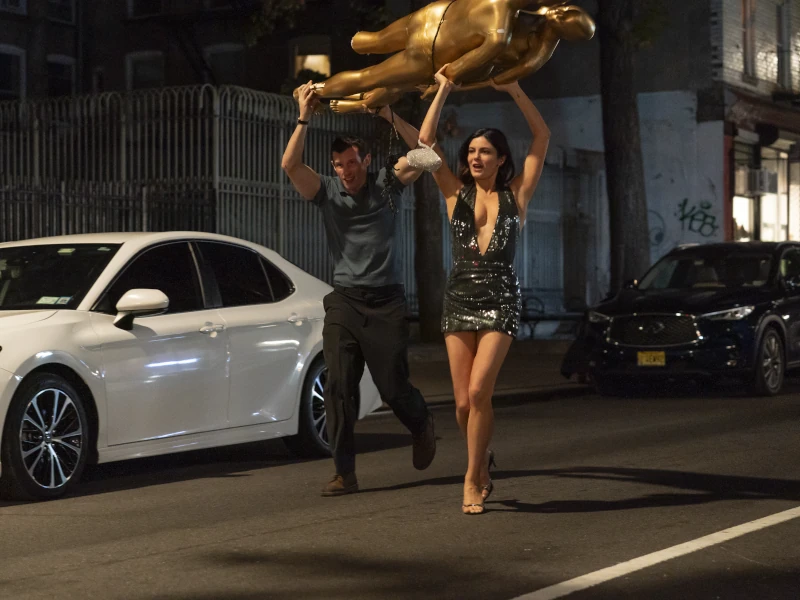
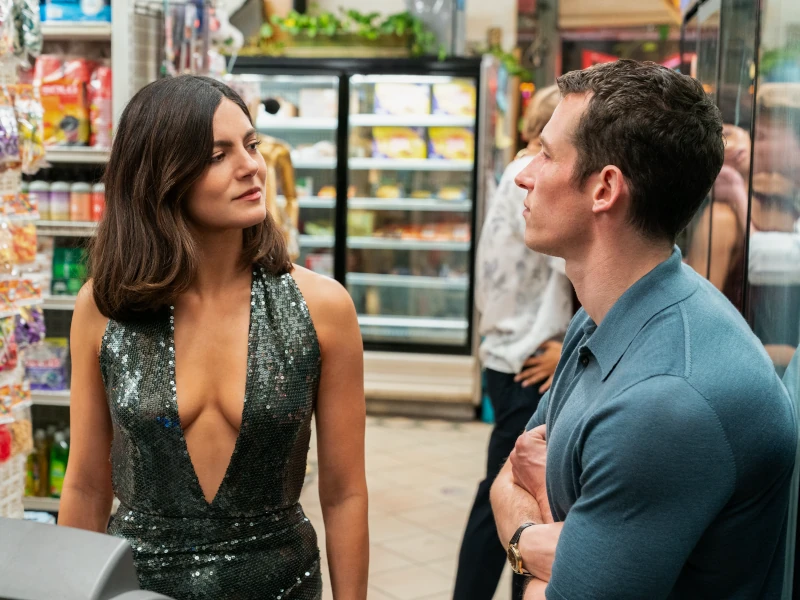
Will Gluck’s One Night Only is, in many ways, a very standard romantic comedy. You’ve got your beautiful actors (Callum Turner and Monica Barbaro) playing two characters who are both struggling to find true love in the big city. They meet by chance and are initially repelled by each other, but after they keep showing up in the same places during a series of wacky and improbable scenarios, they slowly start to realize that maybe they’re perfect for each other. It’s rom-com 101, another iteration of the same kind of formula that has spawned countless thousands of Hallmark and Netflix movies.
What differentiates One Night Only is its attention-grabbing dystopian premise: in this version of the United States, pre-marital sex is illegal except for one night a year. Every August 7th, single people around the country race to find someone to hook up with during the annual 24-hour window, lest they go another 365 days without sex. To ensure compliance, the government has teamed up with a tech company to implant color-coded tattoos on everyone’s wrist, allowing the police to monitor and track down any unauthorized shenanigans.
I’m sure you have hundreds of questions already, and you still will once you’ve finished watching the movie. Gluck (Anyone But You, Friends with Benefits) and screenwriter Travis Braun have little interest in interrogating what a law like this would mean for the country and its citizens, content instead with making a few cute zingers before quickly going back to watching our two single millennials have one crazy night. It’s one thing to do a poor job of examining your own premise, but it’s another thing entirely to ignore it so profoundly that it makes it almost impossible to focus on anything else going on in the movie.
" It’s barely passable if you take it as nothing more than a silly movie, but the beyond-clumsy handling of its high-concept premise makes it an embarrassing effort at best. "
What’s worse, there’s a pretty clear reading of the movie that makes it feel like the filmmakers are actually in favor of the sex ban. We are constantly barraged with the idea that sex without real, genuine connection is meaningless. Things like casual sex, dating apps, and sex workers are treated with a casual disdain. “The fascists were onto something,” someone jokes at one point, in a way that doesn’t really feel like a joke. Even the movie’s conclusion goes out of its way to ultimately embrace the ban, further shrugging off sex as something that just must not be part of getting to know a romantic partner.
If you’re somehow able to miraculously turn your mind off from anything having to do with the sex ban premise, you might find yourself mindlessly entertained by some decent gags throughout. Allie (Monica Barbaro) is a singer who creates musical jingles for pharmaceutical products, resulting in a good running gag in which we continually encounter parodies of popular pop songs transformed Weird-Al-style into commercials for psoriasis medication. There’s a horny 12-year-old who makes vulgar passes at Allie, which are funny unless you think about it happening to a real person. Anything that works in this movie is mostly due to how effortlessly charming Barbaro is, as she exudes a level of likeable naturalism throughout. Callum Turner comes off much worse by comparison, failing to really generate much empathy in his role as Owen, a typical “nice-guy” who owns a pizza restaurant and doesn’t have much else going for him, no matter how many extras turn to gawk at him whenever he passes by.
Both Allie and Owen would love to have sex on the one night they are allowed to, but they both wistfully lament that even if they did, it just wouldn’t be the same as being with someone they actually cared about. Still, as the night goes on, they start to get increasingly desperate. They run all over New York City looking for just the right partner, at one point fighting over one of the last condoms available (because safe sex is also part of the government mandate for this night, even though that would be even more impossible to enforce) after they think they’ve finally found an acceptable candidate. Of course, all of those candidates turn out to be crazy, because apparently there are no normal and decent people left amongst the single population.
There’s a slew of cameos from actors you may or may not know – including Julia Fox, LeVar Burton, Molly Ringwald, King Princess, Nicholas Braun, Pete Davidson, Bobby Cannavale, and Este Haim, just to name a few – all of whom get their opportunity to make our main duo feel even worse about the fact that they aren’t having sex on this blessed day. Eventually, Allie and Owen start to get to know each other better and eventually catch feelings, but at this point, who really cares? There’s very little chemistry between Barbaro and Turner, and their developing attraction is buried underneath several layers of other insane stuff that’s going on.
And if all of this is feeling a little heteronormative to you, don’t worry: Allie’s roommate (Quintessa Swindell) shows up briefly to hand-wave away those kinds of questions. “This night is for the straights,” she says, before suggesting that queer people have always found a way to get around these kinds of silly laws. Not only does this not make any sense (because they would also have the government implants) but it also sort of implies that queer people have always been breaking laws, whether legal or moral.
Despite the occasional appearance of a few “APPEAL” signs and some low-level grousing about the ban, there is really no sense of any resistance in this world. Everyone seems fairly content to go on with their daily lives, and the day the ban gets lifted feels more like a celebratory holiday than any kind of somber call to action. The movie does its best to be about anything other than what you want it to be about. In interviews, Gluck has only said that the movie is an allegory for single people and dating. “This is what it feels like,” he says. “Everyone else seems to be doing it all around you, and you’re not, and you have this short period of time.”
A quote like that suggests one of a few things, none of them good. Either A) Gluck was happy to gloss over any real-world connotations and simply use the story’s premise as nothing more than a surface-level joke machine, B) he didn’t even understand what he was really saying by telling the story in this way, or C) he totally understood what he was doing and has some really archaic and conservative ideas about sex. If he did think he was making some profound statement about bodily autonomy or how susceptible we are as a country to accept the chains of fascism, the movie’s ending completely undermines those points.
There will be those who will say One Night Only is just a mindless rom-com, the kind of movie that shouldn’t be taken so seriously; but you can’t just put a sharp object in a box with silly wrapping paper and expect us to only play with the box. It’s barely passable if you take it as nothing more than a silly movie, but the beyond-clumsy handling of its high-concept premise makes it an embarrassing effort at best.